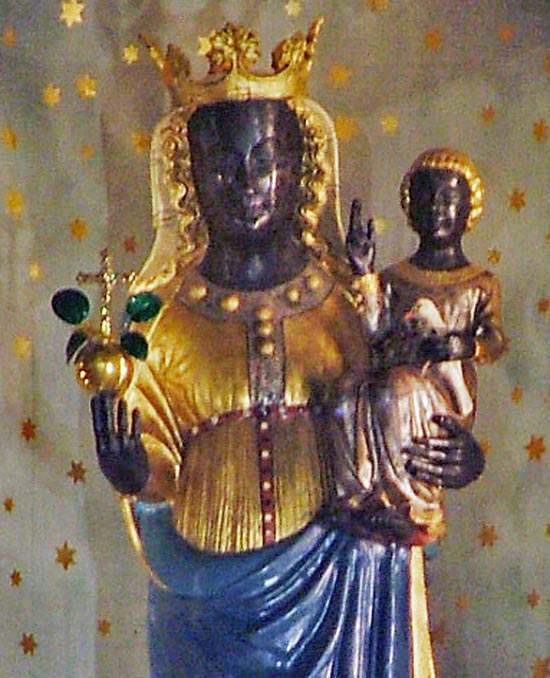
At major sanctuaries to the Black Madonna throughout Italy and beyond, devotees over the centuries have made offerings known as ex-votos, Latin for “out of a vow,” to give recognition for healing received at a time of great need.
This art of gratitude often takes the form of a narrative painting with the words “PGR,” per grazia ricevuto – for grace received – along with an inscription of the specific details of the circumstances of the event.
More than 10,000 ex-votos in Italy have survived the ages, although many have been lost, stolen, or destroyed.
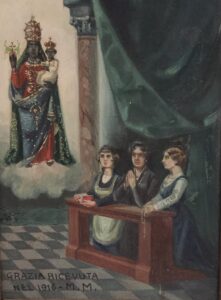
These testimonies of divine connection provide a fascinating insight into the past. They offer a historical record of everyday dangers and communal catastrophe. At the same time, they tell of survival, resilience, and collective action. Making offerings at sacred sites is an ancient practice, as evidenced by devotional items found throughout Italy.
The viewing of ex-votos invites us into conversation across time and suggests a meaningful spiritual practice that can be utilized today. They ask us to pay attention to not only what has happened in the places we inhabit, but also to what is happening. They encourage us to ask: What am I grateful for? Who is helping me? How am I acknowledging that? What am I giving back in return for the gift I received?
As we seek deeper connections that carry us forward into uncertain times, creating expressions of gratitude offers a practice of relationship and reciprocity with the natural world.
“The Art of Gratitude: The Enduring Value of Ex-votos to the Black Madonnas of Italy,”presented to the Pacific Northwest American Academy of Religion, George Fox University, Newberg, Oregon, May 20, 2023.
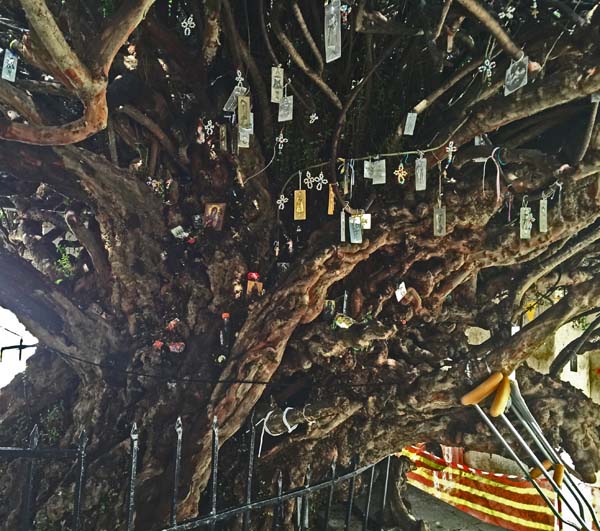
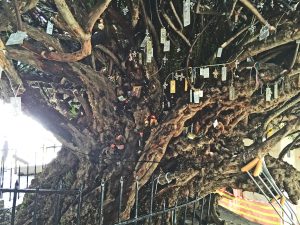 Of all the sites in Crete that beckoned, it was the thousand-year-old Sacred Myrtle Tree that I most looked forward to visiting. I had first read about it in 1995, in Carol Christ’s Odyssey to the Goddess.* Carol described the Panagia Myrtià, the All Holy Myrtle, as a place of veneration, tended by the local nun’s, and extremely sacred. At that time, I was about to begin my own odyssey over the months and years to come, first encountering the Black Madonna while doing genealogy research in Italy, and then returning to Italy to delve deeply into my ancestral heritage. Now, here I was in 2015, twenty years later, gathered at the base of the Sacred Tree with Carol Christ and a group of women as part of a
 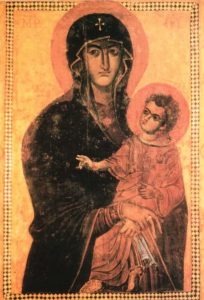 This summer I received a postcard from a friend in Italy portraying the Madonna in the Basilica of Santa Maria Maggiore, the major church in Rome dedicated to the Virgin Mary. Far more than a just a beautiful image, this Black Madonna has been attributed with miraculous and awesome power. Her titles “Our Lady of the Snows” and “Salvation of the Roman People” offer clues of her power over the weather and her ability to protect a whole community.
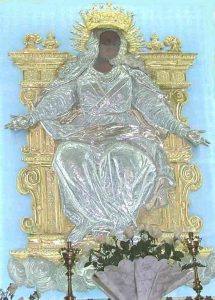 In 1995, I took a sabbatical from my job to do genealogical research in Italy. My journey started with a pilgrimage to Goddess sites in southern Italy with a small group of women, led by archaeologist Frances Bernstein. I had been going to Italy for 20 years. But it had never occurred to me that among all the ruins and hidden in the churches and in nature were places once sacred to women and men who honored female divinities.
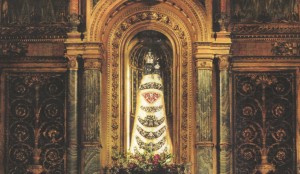
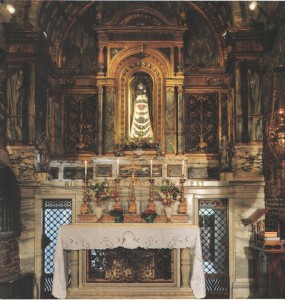 December is the darkest month here in the northern hemisphere, a time of going within to access the dark maternal matrix of creation. On liturgical calendars throughout Italy, December 10 is the date dedicated to the Black Madonna of Loreto. The sanctuary of Loreto in Ancona, Le Marche, is a major pilgrimage site of Europe with millions of visitors a year. Considered to be the protector of Italy, the Madonna of Loreto is a highly revered and well-known. Sibyls and prophets adorn the outside of the marble enclosure of the Santa Casa, or Holy House, in which her image is venerated. As one enters the small shrine within the large church, there is a feeling of intimacy and accumulated devotion.